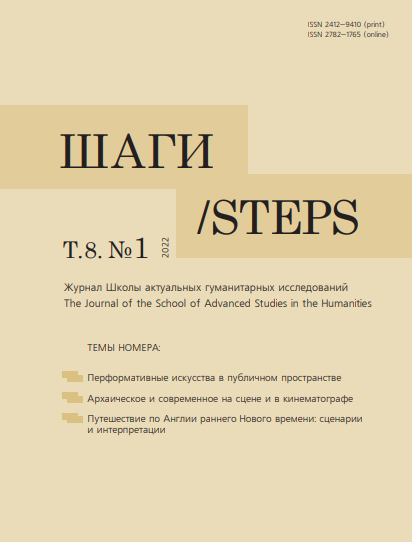
The peer-reviewed journal "Shagi / Steps" has been published since 2015 by the School of Advanced Studies in the Humanities at the Institute for Social Sciences of the Russian Presidential Academy of National Economy and Public Administration (RANEPA). The journal discusses topical problems of modern humanitarian knowledge, including ancient culture, Oriental studies, comparative linguistics, historical and cultural studies, cultural studies and social communication, and theoretical folklore studies. The editorial board of "Shagi" includes major Russian and foreign scholars in the fields of Russian and world literature, folklore, ethnography, anthropology, history, art history, and linguistics. Authors of the journal include respected researchers from various regions of Russia and other countries. Articles can be found in both Russian and English.
Founded: 2015
Frequency: 4 issues per year
Open Access: Platinum Open Access (Creative Commons Attribution 4.0 International)
Publication Fee (APC): no publication fees
Languages of Publication: Russian, English
Indexing: Scopus, DOAJ, Erih Plus, Hungarian Scientific Bibliography Database, UlrichWeb Global Serials Directory, Open policy finder (бывш. Sherpa Romeo), Scilit, OpenAlex, Wikidata, Scholia, Fatcat, DNB, CrossRef, CNKI, Russian white list, Russian Science Citation Index, Russian Journal Rank RCSI
Current issue
ОТ РЕДАКТОРОВ
ANCIENT EGYPT IN THE MIRROR OF MEDIEVAL TRADITION
The Сlassical motif of the great Egyptian king-conqueror who ruled in the remote past was usually analyzed regarding the alleged scale of his conquests (e. g. the outcome of his assault on Scythia) but the presentation of their purpose and the organization of his possessions remained untouched. The earliest account of the king Sesostris by Herodotus (II.102–110) tells virtually nothing about that. Pompeius Trogus, deriving his evidence from some earlier source, made a telling remark that the Egyptian king Vesosis and his Scythian counterpart Tanaus sought not power (imperium) for themselves but rather glory for their peoples, unlike the Assyrian king Ninus, who craved territorial dominion and made the conquered lands his permanent possession (Iust. I.1.7). Diodorus Siculus, probably reproducing the work on Egypt by Hecataeus of Abdera (late 4th century BC), ascribed to the Egyptian conqueror Sesoosis a rather mild treatment of subdued peoples, levying on them regular tribute and using the labour of prisoners of war (Diod. I.55.10–12, 56.2). At the same time Diodorus tells a story of the king’s habit to place the subdued rulers four-in-hand under the yoke in his chariot (Ibid. 58.1–2); this motif obviously extrapolates the Assyrian practice onto reminiscences of Egypt’s past and is eventually known in Roman and Byzantine tradition. In addition, Roman authors compare the Egyptian empire of the past with the contemporary Roman and Parthian empires (Tac. Ann. II.60.3; cf. Strabo XVII.1.46). It seems that the earlier tradition preserved real memories of Egyptian possessions of the 2nd millennium BC as a sphere of influence distinct from the centralized empires of the 1st millennium BC, but in Roman times they were likened to such states.
The author tries to show that the Arabic tradition about ancient Egypt, reporting on King Nadares (Tudaris, Badaris), the father of King Malius (the latter renounced paganism and tried to introduce monotheism, thus his obvious prototype is Akhenaten), reflects the reign of Akhenaten’s actual father, Amenhotep III. Its three main plots about Nadares: the construction of a temple of Venus with an idol made of lapis lazuli and with a source of healing water; the campaign against a prince from Syria-Palestine; a victorious campaign in response to an attack by blacks from the south and an unprecedented advance to the south — find direct parallels with the events of the reign of Amenhotep III: receiving from Mitanni (the supplier of lapis lazuli for Egypt) a magical statue of Ishtar (later identified with Venus) for the purpose of healing Amenhotep; military actions in Syria to pacify local princes (EA 85, EA 108, EA 117, EA 152); the campaign to the south in the 5th year of Amenhotep’s rule in response to hostile actions of a local chieftain of the blacks, with an advance, according to inscriptions, much further south than ever before. The Islamic-Egyptian tradition about Nadares must be viewed as the result of continuous transmission of reminiscences of Amenhotep III since his own reign, which is a particular case of the general relation of the Islamic-Egyptian tradition to the ancient Egyptian one.
The article deals with the image of King Cambyses II in Coptic and Late Arabic traditions. According to the author, the identification of Cambyses II with Nebuchadnezzar II occurred in Egypt due to the fact that both rulers were perceived as adversaries of religion and were reputed to destroy temples in conquered territories. However, the Coptic and Arabic versions of the story of Cambyses’-Nebuchadnezzar’s invasion contain some elements that can be regarded as a reminiscence of the historical campaign of Nebuchadnezzar II against King Apries. The appearance of such elements in the context of Egypt’s loss of independence may be linked to the tradition of King Apries’ supporters of the 6th–5th centuries BC, who considered him to have been the last legitimate ruler of Egypt and the following reign of Amasis as an interruption of Egyptian history. This tradition was blended with the representation of Cambyses’ invasion as a crucial point in Egypt’s history into the Coptic version of the story of the Egypt’s loss of independence during Cambyses’-Nebuchadnezzar’s attack on King Apries. In the Coptic “Cambyses’s Romance” and the “Chronicle” of John of Nikiu there is still a distinction between Cambyses II and Nebuchadnezzar II, but in the Arabic tradition both figures were merged into a single image of King Bacht-Nassar, and the conquest of Egypt was attributed to this “hybrid” ruler.
Based on a study of an extensive compilation by PseudoMasudi, “Abridgement of the Curiosities [of Egypt]” (first quarter of the 2nd millennium AD), this article examines the understanding of the Arab-Muslim tradition (i. e., primarily the Arabic-speaking Islamized Egyptians of the Middle Ages) of ancient Egyptian statues and their magical features. Various groups of statues in this tradition are identified and classified according to their functional and other traits. The functions of the statues reproduce, to a high degree, the corresponding clichés in the ancient Egyptian literary tradition and actual ritual practice, developing them through literary and fairy-tale fantasy, in combination with impressions of the numerous ancient statues easily visible in Egypt, even though they had ceased to be objects of active cultural practices. Less reproduced is that part of ancient Egyptian literary clichés where wax or clay, rather than stone, is used as the material for sculptures (stone statues were observed in reality). More direct ancient Egyptian relics can be seen in examples where magic statues differ from the rest in their mode of action, correlating with ancient Egyptian magical practices. This material confirms the continuity of cultural history from the ancient Egyptians to their direct medieval Arabized and Islamized descendants.
The article examines the plot concerning a lame king of Ancient Egypt who overcame a king of Jerusalem, as transmitted in the works of Arabic medieval historians, including Ibn Abd alHakam and Maqrizi. According to their writings, the lame Egyptian king captured Jerusalem and imprisoned its ruler. However, the question of who was the historical prototype for this king and whether this king even had such a prototype remains open. The article suggests that the figure of the “lame king” was a representation of several Egyptian rulers, both real and legendary. The main prototype was the Pharaoh Necho II of the XXVI Dynasty, who defeated Josiah, king of Judah, and captured his son Jehoahaz during his campaigns in Syria and Palestine. Besides him, elements of other Egyptian rulers also contribute to the image of the “lame king”; he was credited with the exploits of Shoshenq I, the founder of the XXII Dynasty (Libyan in nature). In addition, the descriptive characteristics of the “lame king”, namely his great might and pride, indicate that the Arabic accounts reflected in their own way the image of the legendary Egyptian king-conqueror Sesonchosis.
COMMENTARIES TO CLASSICAL TEXTS: OLD PROBLEMS AND NEW APPROACHES
This article examines the functions and aesthetic evaluation of prologues in ancient Greek drama based on classical sources. Through a comprehensive analysis of Aristotle’s Poetics and Rhetoric, Aristophanes’ comedies, and fragments of other comic poets (such as Machon and Antiphanes), the study explores how prologues were perceived in antiquity — both in terms of their structural purpose and their qualitative assessment. A key distinction is made between tragic and comic prologues: while clarity was prioritized in tragedy, comedy demanded additional elements of entertainment and humor in order to engage audiences. The central focus of the article is the concept of the “cold” (ψυχρός) prologue, particularly in reference to critiques of Diphilus’ comedies. The term is analyzed in its various possible meanings — ranging from “unclear” and “tedious” to “unfunny” — and contextualized within the framework of ancient literary criticism. The discussion incorporates passages from Xenophon, Theophrastus, and comic fragments to demonstrate how ψυχρός functioned as a pejorative label, often associated with failed attempts at humor, excessive complexity, or dull exposition. Additionally, the article examines an anonymous comic prologue (Com. Adesp. fr. 1008 K–A) to illustrate how excessive detail or length could undermine a prologue’s effectiveness. The study concludes that an ideal prologue in ancient drama balanced exposition, clarity, and entertainment, with “coldness” arising from a disruption of this equilibrium. By reconstructing ancient evaluative criteria, the article sheds light on the performative and rhetorical expectations of prologues, contributing to broader discussions about genre-specific aesthetics in Greek theater.
This article examines allusions to the Athenian political figure Archedemus in Aristophanes’ Frogs. In Frogs Archedemus receives only two mentions by name (Ran. 416–421, 588). In the first, the chorus urges Dionysus and Xanthias to have a good, joint laugh at Archedemus. The second mention occurs in the oath of Dionysus: “May I myself, my wife, my children perish, and bleary Archedemus, all together!” The basis for my argument that Archedemus is actually ridiculed twice more in Frogs is his nickname mentioned in verse 588 — γλάμων. The first unnoticed allusion appears in the prologue, when Xanthias says that he couldn’t have participated in the sea battle of Arginusae because he had the pinkeye. Xanthias’ words seem random without any referent, and considering the other passages discussed, the most likely candidate is Archedemus. The second unnoticed allusion to Archedemus in Frogs is also connected with the battle of Arginusae. In the debate about prologues to tragedies, Aeschylus retells the story of King Oedipus. After Aeschylus’ words “εἶτ’ ἐξετύφλωσεν αὑτόν” Dionysus makes the following remark: Εὐδαίμων ἄρ’ ἦν, εἰ κἀστρατήγησέν γε μετ’ Ἐρασινίδου (Ran. 1195–1196). Oedipus, having entered into an unequal marriage with an older woman, deprived himself of sight. It should be remembered here that the chorus speaks of Archedemus as the villain par excellence of Athens. Considering his partial blindness, perhaps Dionysus’ unexpected reference to Oedipus reminded the audience of another individual of questionable morals who was absent at the battle of Arginusae but managed to be the first to accuse Erasinides of embezzlement.
The article deals with a passage from The Life of Abraham by Philo of Alexandria (Abr. 73), in which the author uses the metaphor of a puppeteer and puppets to describe both the relationship between the mind and the senses and the relationship between God and the world. It is common to see in this passage the image of automatic puppets, which the puppeteer sets in motion by loosening the strings and giving them freedom, and stops by tightening the strings. However, an analysis of parallel passages in which Philo describes the mechanism of sensation shows that for him, at the moment of sensation, the mind sets the senses in motion by ‘reaching out’ to them with its ‘forces’ rather than by letting them go free. Such a description corresponds to another puppet image — that of marionettes, which the puppeteer sets in motion by pulling the strings and stops by letting them go. Just such a metaphor must also be implied by the word neurospastein, used by Philo in relation to the work of the mind and sensations in Quaest. in Gen. 1, fr. 24. The image of a controlled puppet enables Philo to illustrate all three elements of sensation: the mind corresponds to the invisible puppeteer, the senses to the puppets led by him, and the forces of the mind channeled from it to the senses are the threads pulled by the puppeteer.
This paper deals with the publication of a fragmentary inscription discovered during the 1990 excavations by I. A. Antonova of the 19th curtain wall of Tauric Chersonese. According to the proposed reconstruction, the monument is a dedication to Eros and represents the first indisputable written evidence of the cult of Eros in the North Pontic (North Black Sea) region. The text reads as follows: “[So-and-so, son of so-and-so,] fulfilling the duties of a king, being a priest, [for the salvation of the city?] dedicated to Eros Hetaireios”. The dedication was made by a citizen who held the eponymous office of basileus and was also a priest of Parthenos, the supreme goddess of Tauric Chersonese. The rare cult epiclesis Ἑταιρεῖος (“Hetaireios” or “Friendly”) mentioned in the inscription was not previously attested in connection with Eros in the ancient tradition. The functions of Eros Hetaireios as a deity-guarantor of civic solidarity were in demand during the political crisis of the late 4th and early 3rd centuries BC, which was reflected in the civic oath of the Chersonesites (IOSPE I2 401). One of the main motives of this document is the need to maintain ὁμόνοια (“unanimity”), that is, civic solidarity and internal unity of the polis.
The article offers a comprehensive interpretation of verse 153 of Nicander of Colophon’s didactic poem Theriaca, in which the seps — one of the varieties of poisonous snakes — is compared to a snail. The passage is analyzed both in the context of the passage about the seps (145–156) and in relation to the literary tradition of Greek didactic epic poetry. Analysis of this comparison shows the inconsistency of its generally accepted interpretation, based on the fact that the snake and the snail are similar in color. On the contrary, the author of the article suggests that the passage in question in Nicander’s Theriaca is more likely to be influenced by a different kind of external resemblance rather than color — for example, the texture of the skin of both animals or the coiled shape of the snail’s shell and of the body of the snake. Furthermore, the author reveals the Hesiodic subtext in the comparison of the snake to the snail, and points out that Nicander creates it by means of a reference to Hesiod’s ‘Works and Days’. This reference is based on the descriptive designation of the snail, which in its manner is strongly reminiscent of the so-called ‘kennings’ in Hesiod’s didactic poem.
The article analyzes an instance of intertextuality in the second book of Silius Italicus’ Punica. The author focuses on fragment II.177–187 with its mention of Eurydamas, a descendant of one of Penelope’s suitors, among the defenders of besieged Saguntum. The description of this ancestor’s actions, particularly the claim about Odysseus’s death, corresponds in Homer’s Odyssey not to Eurydamas, but to another suitor — Eurymachus. The work examines the hypotheses proposed in historiography to resolve this contradiction. The first suggests that Silius makes the Eurydamas in Punica a descendant of Eurydamas from the Odyssey. The second hypothesis proposes an error by Silius, who confused Eurydamas with another, more prominent suitor of Penelope — Eurymachus — or a similar accidental scribal error. Finally, some scholars suggest an intentional ambiguity concealing a reference to Eurymachus. The author criticizes the first two versions, pointing to the unlikelihood of a random scribal error or a mistake by the highly erudite Silius. The use of a minor Homeric character and Silius’s supplementation of the Homeric tradition also seem improbable. The author supports and elaborates on the third hypothesis proposed in historiography: Silius deliberately uses the name Eurydamas to demonstrate his erudition and create an intertextual reference, while the description unequivocally points the educated reader to Eurymachus. Such ambiguity, according to the author, aligns with the overall poetics of Punica as a work rich in allusions. The proposed interpretation resolves the contradiction without textual emendations and fits Silius’s method of complex literary play with sources.
The episode with the Trojan embassy occupies a central place both in terms of plot and structure in the 5th-century poet Dracontius’ epyllion “The Abduction of Helen” (De Raptu Helenae = Romulea 8 = Rom. 8). It is after the failure of peace negotiations with Telamon regarding the return of Priam’s sister Hesione, i. e., the main mission of the ambassadors, that the kidnapping of Helen — the key event of the poem — occurs, followed by the Trojan War. The author’s words opening the scene have not been the subject of special research or commentary until recent years. It was only in 2019 that the German researcher K. Pohl, author of the most recent translation and edition of ‘Helen’ to date, drew attention to them. It concerns the characterization of the delegates: that those “under the guise of peace bring not peace but war” (Rom. 8.255–256). To the question whether these words contain direct criticism of the ambassadors, whether Dracontius considers them, at least in part, guilty of further tragic events, Pohl answers in the affirmative, implying first of all the unprofessional behavior of the negotiators. Diaz de Bustamante, relying precisely on the episode with Apollo’s prophecy, once called doom the main force responsible for the war, but in a positive way for the Trojans: after all, the deity promised them “unlimited power”. Since the researcher did not give any further arguments, and Apollo did not seem to act in the interests of the Trojans and tried to lead them astray, this point of view was rejected in the scholarly literature — and, as I try to argue, it seems unfair.
The Old Armenian translation of the Ars grammatica of Dionysius Thrax (second half of the 5th century) is considered the first translation of the Hellenistic school, with its literal rendering of the original and its language full of neologisms, artificial grammatical forms and syntactic constructions. This translation, in which the core of the Armenian grammatical terminology was created, initiated the study of the Armenian language. The translator combined the attribution of grammatical categories borrowed from Greek to Armenian, to which they are not characteristic, with the creation of artificial grammatical forms that deviate from the original and describe the real features of the Armenian language. In the period from the 6th to the 11th centuries five commentaries on Dionysius’ grammatical work were written. In the 11th century Grigor Magistros and in the 13th century Yovhannēs Erznkats‘i wrote their compilatory commentaries, incorporating the previous five into them. Grigor Magistros also retold Homer’s biography based on classical sources and narrated the citations from Homer in a broader context. Later, five more commentators — Vardan Arewelts‘i (13th c.), Esayi Nch‘ets‘i and Yovhannēs Tsortsorets‘i (both lived in the 13th–14th centuries), Aṛak‘el Siwnets‘i (14th–15th centuries) and David Zeyt‘unts‘i (late 16th c.) — wrote commentaries on the grammar of Dionysius. The article shows how different authors, retaining over the centuries the same tradition, tried to overcome the description of Armenian by means of grammatical categories non-characteristic of it.
The ancient Greek Alexander Romance by Pseudo-Callisthenes, translated into Armenian probably in the 80s of the 5th century, has come down to us in two complete and two abridged recensions, as well as in a medieval oral version, written down later and preserved in manuscripts. The two complete recensions (only one of which has been published) are slightly modified versions of the original translation. Comparing them with the two earliest Greek recensions, α and β, gave me and Gohar Muradyan the opportunity to prepare a new critical edition of the Old Armenian version of the Alexander Romance which reflects the state of the text closest to the original translation. Although the translation is quite accurate, often even literal, both the translator and the two revisers used some elements of interpretation or moderately altered the text. The article presents some of the most interesting examples of such changes. The translator sometimes armenianized the text (for example, replacing Zeus with Aramazd). The author of the first complete edition A, the 13th–14th century poet Khach‘atur Kech‘aṛets‘i, embellished the text with short poems (often on biblical themes) and added four ethopoeias at the end, as well as a comparison of Alexander with Christ. He inserted some brief explanations in order to make the text more understandable to medieval Armenian readers. The anonymous author of the second complete edition, D, which apparently already existed in the 10th century, like Khach‘atur, slightly modified the text at some places, inserted in it a passage from the Armenian translation of Pseudo-Methodius’ Apocalypse describing the twenty-two barbarian peoples and an apocryphal story about how Alexander transferred the remains of the prophet Jeremiah to Alexandria. He also composed a letter of the dying Alexander to his mother and added a few minor details.
This paper presents the editio princeps, alongside an English translation and commentary, of the anonymous Armenian scholia on Pseudo-Gregory of Nyssa’s Contra Manichaeos. In Greek sources this work is attributed to Didymus the Blind and John of Caesarea (the Grammarian). In medieval Armenian literary tradition it was attributed to the Neoplatonic philosopher David the Invincible and was considered to be the final chapter of his major philosophical work, Definitions of Philosophy (the Armenian version of his Prolegomena philosophiae). In Armenian manuscripts it appears without a title, with the incipit “Every evil is punishable” (Ամենայն չար տանջելի / Amenayn chʻar tanjeli). The prominent Armenian author Catholicos Nersēs Shnorhali (1102–1173) wrote a commentary on the Amenayn chʻar, describing it as “very small in quantity, but very great in quality”. In the mid-14th to 15th century, the theologian Aṛak‘el Siwnets‘i composed an extensive commentary on the Definitions, including the Amenayn chʻar. An anonymous Armenian author wrote scholia to both the Definitions and the Contra Manichaeos / Amenayn chʻar (the earliest extant example of which dates back to 1489). The scholia on the Amenyan chʻar contain concise explanations of individual words and expressions, such as: “every evil is punishable”, “an accident”, “all the contraries”, “the mutable good” etc. The anonymous author made extensive use of the commentaries on the Amenayn chʻar by Nersēs Shnorhali and Aṛakʻel Siwnetsʻi; however, he also provided examples and considerations that differed from them. These scholia most likely served a practical and educational purpose, being used as auxiliary material for studying the Amenayn chʻar and its commentaries.
The article analyzes the “blue cloak” (í blári kápu) formula in the Íslendingasǫgur and examines the limits of its interpretation as a sign of aggression. Based on a systematic analysis of a corpus of references to “blue” clothing in family sagas, the study demonstrates that saga characters generally do not perceive the color blár as an unambiguous signal of violent intent: in most cases, they either do not react to such clothing at all or recognize individuals wearing it, since garments of this color frequently serve to mark social distinction and status. Expectations of aggression within the saga world arise only in a small number of cases and depend on situational and relational context rather than on color alone. The article pays special attention to the question of why blár nevertheless becomes associated with violence at the level of narrative convention. Drawing on evidence from color semantics and on the social and material status of dyed textiles in medieval Iceland, the author aligns with the view that within the narrative of the “saga world” blár primarily denotes special, non-everyday clothing associated with significant actions and social prestige, which helps explain its frequent appearance in episodes involving conflict without functioning as a stable diegetic signal of aggression. A key exception is discussed in relation to Valla-Ljóts saga, where the association between blue clothing and violent intent is explicitly verbalized and recognized by other characters; this episode is interpreted as a marked deviation from standard saga practice, possibly parodical, in which a narrative convention normally addressed to the audience becomes incorporated into the fictional world itself. On this basis, the article concludes that the “blue cloak” operates primarily as a convention shaping audience expectations rather than as a shared semiotic code among saga characters.
The article discusses Nersēs Lambronatsʻi’s (1153– 1198) translation and adaptation of the commentary on the Book of Revelation. It reveals the motivations that prompted Nersēs to undertake the translation, which holds significant value within the Armenian Apostolic Church legacy. As a source for his translation Lambronatsʻi used the Greek original by Andrew of Caesarea (AD 563–614). In his colophons, Lambronatsʻi notes that he delivered the Greek original to the Catholicos of Rumkale, Gregory IV Tgha (1173–1193), who entrusted with its translation the metropolitan of Hierapolis, Constantine. It was with Constantine that Lambronatsʻi made the initial translation of the Commentary. But why is the translation now attributed only to Lambronatsʻi in Armenian literature? The fact is that Constantine was Greek, most likely had not mastered Classical Armenian, and so turned the original text into the colloquial Armenian of that time. Subsequently Lambronatsʻi himself revised the translation and adapted it to the patterns of literary Armenian. Furthermore, he made many changes to the text, adapting it to Armenian religious thought, so that the Armenian text is valuable as an almost independent work. This research highlights the textual discrepancies between existing printed versions and ancient manuscripts, justifying the necessity for a new critical edition of the text.
This article examines passages from George of Pisidia’s Hexaemeron (7th century) as they appear in the Commentary on the Book of Psalms by the Armenian exegete Nersēs Lambronatsʻi (1153–1198), one of the leading figures of medieval Armenian scholarship. The study aims to determine whether Nersēs Lambronatsʻi used the Greek original or the Armenian translation of the poem and to analyse his method of integrating these sources into his exegetical practice. The research is based on the fully preserved 13th-century manuscript 1526 from the Matenadaran, Yerevan, which represents a major example of Armenian palaeography and contains a complete, previously unpublished commentary on the Psalms. A textual and palaeographic analysis demonstrates that Nersēs Lambronatsʻi consistently relied on the Armenian translation of the Hexaemeron. The commentary incorporates direct quotations, paraphrases, and distinctive narrative and imagistic elements absent from the Greek original. This reliance is particularly evident in the interpretation of Psalm 135, where literal and allegorical exegeses are intertwined, integrating the translated text with patristic sources. Nersēs Lambronatsʻi creatively reworks the translation, preserving its semantic and stylistic framework while adding his own exegetical commentary. Based on several examples, it is shown that Nersēs Lambronatsʻi used not the Greek original but the Armenian translation of the poem — specifically the complete translation, rather than the later abridged version that has come down to us in the Venetian manuscript. These findings demonstrate the systematic use of the Armenian translation of George of Pisidia’s Hexaemeron in Nersēs Lambronatsʻi’s commentary, highlighting both direct quotations and nuanced paraphrases. By examining lexical choices, narrative motifs, and imagery, the study shows that Nersēs Lambronatsʻi creatively integrated his Byzantine source into the Armenian exegetical tradition. This analysis not only clarifies the author’s textual method but also sheds light on broader patterns of Byzantine–Armenian literary transmission, contributing to our understanding of the interaction between translated texts and native exegetical practices in medieval Armenia.
The article analyzes the Old Provençal texts of the 13th century known as vidas and razos. These short texts have been preserved in manuscripts alongside the lyrics of troubadours’ songs and represent a kind of commentary — a presentation of the text. They are quite diverse, but all of them contain both a story about the poet’s biography and an explanation of certain passages in his text. It is believed that razos and vidas were composed by jongleurs and minstrels as introductions or explanations of the text performed by singers. The lyrics of the songs and the narratives of the vidas/razos were composed by different authors, and there could be a gap of several decades between them. A vida/razo can be considered as a commentary that does not clarify the old texts but rather creates new meanings. These new meanings are related to the changes that occurred in the attitude towards courtly poetry and the author-work relationship in the 13th century. These changes are analyzed in Michel Zink’s monograph “On Subjectivity in Literature: Around the Age of Saint Louis,” to which the author refers. The article analyzes the razo to a canso by Bernard de Ventadorn and the vida of Jaufre Rudel. These texts are presented in the article as a special case of patterns characteristic of 13th-century literature. The analysis proposed by the author opens up a new approach to the study of the vidas and razos in their correlation with the corresponding cansos of 12th-century troubadours.
Depictions of the afterlife (places of bliss and suffering, heaven and hell) appear in medieval literature in several genres. Traditionally, these are “afterlife visions” and “miracles” (the article analyzes Gonzalo de Berceo’s Miracles of the Virgin Mary), which existed as a separate genre and as part of hagiography. At the same time, images of the afterlife are also represented in secular genres, in particular the Spanish Book of Alexander, which transformed the traditional topos in light of emerging medieval ideas about hell. The article analyzes the medieval topic of the afterlife, as well as various ways of creating the effect of the presence of otherworldliness (from direct description to creating an atmosphere of otherworldliness by appealing to the various senses and emotions of the listener /reader). A commentary on the relevant fragments of these texts shows that traditionally fantastic images in descriptions of the afterlife and its inhabitants (in the Latin Alexandriade and The Miracles of the Virgin Mary), in Spanish translations and adaptations take on a noticeably realistic and plausible appearance — hell in the Spanish Libro de Alexandre is arranged like a medieval city with all its mandatory attributes (walls, market, cathedral), and the appearance of Satan and his entourage in The Miracle of Theophilus from the collection of Gonzalo de Berceo (unlike the Latin original and the version by Gauthier de Coinci) is depicted as a religious procession.
The article analyses the semantics of the name of the narrator and addressee of Contes amoureux, a French collection of adaptations from Italian narrative sources published under the pseudonym Jeanne Flore. This collection is an example of “editorial writing” — a collaborative effort by several authors commissioned by a printer or bookseller. The paradoxical double name, Madame Egine Minerve, combines the virgin goddess of wisdom and one of the nymphs kidnapped by Jupiter, as described in Ovid’s Metamorphoses and its medieval adaptations. The second part of the name refers to Marguerite de Navarre, who was renowned for her virtue, while the first part allows her to be portrayed in the text as Cupid’s servant. An analysis of French translations of the Decameron reveals an unexpected connection between the name Egine and a personage in one of Boccaccio’s novellas included in the collection. It can be assumed that the narrator of Boccaccio’s novella responds ironically to Madame Minerve, describing her transition to the power of Cupid (under threat of hellish torment). This literary game, based on the clash between the Christian value system present in The Decameron and the mythological (poetic) and pseudo-courtly system underlying Les Comptes amoureux, clarifies one of the mysteries of the collection and sheds light on some of its structural elements.
This article examines Armenian translation of Antonio de Guevara’s Libro áureo de Marco Aurelio, produced by the Armenian merchant Gabriel Hamazaspyan and published in Venice in 1738. The study offers a detailed comparative analysis of the Spanish original and the Armenian translation with the aim of assessing the degree of textual accuracy, identifying the translator’s dominant strategies, and determining whether the translation involves narrative reinterpretation or artistic reworking. Particular attention is paid to syntactic calquing, the preservation of rhetorical and epistolary structures, and the use of morphological and lexical innovations characteristic of Latinized Grabar. The analysis demonstrates that Hamazaspean consistently prioritizes functional equivalence and formal correspondence, reproducing the syntactic complexity and rhetorical cadence of the source text with remarkable precision. Cultural adaptation is limited and primarily pragmatic, serving didactic clarity rather than ideological transformation. No evidence of independent narrative invention or creative rewriting is observed. The article situates the translation within the broader intellectual context of the Armenian Enlightenment and the activities of Armenian merchant communities, which played a crucial role in the transmission of European moral and philosophical literature. By integrating a key work of Spanish Renaissance humanism into the Armenian literary tradition, Hamazaspean’s translation contributed to the formation of secular prose and the expansion of moral-didactic discourse in eighteenth-century Armenian culture. The study thus highlights the translation as both a philologically rigorous undertaking and a significant act of cultural mediation between early modern European and Armenian intellectual traditions.
JUBILEES
News and announcements
2025-09-17
Shagi / Steps has been included in the new Russian White List of scientific journals
On September 12, 2025, the Russian part of the Unified State List of Scientific Publications - the “White List”, recommended for publications by researchers and scientists, as well as monitoring and evaluating the publication activity of Russian scientists was published. The journal Shagi / Steps was assigned the highest (first) level in the new list. Only 634 journals out of 3120 included (as of 09.09.2025) received the first level in the list.
In the previous version of the White List, Shagi / Steps was at level four. The improvement of positions in the list became possible due to the qualitative growth of the journal's scientometric indicators, as well as the improvement of editorial and publishing policies. Thus, according to Science Index data, the journal took 15th place in the subject of “Literature. Literary Criticism. Oral Folklore”, 23rd in the subject of “Linguistics” and 34th in the subject of “History. Historical Sciences” among all Russian journals in 2024. In 2025, the journal was included in the largest open access publication database DOAJ.
Inclusion in the new White List required each journal to undergo evaluation by specialized and regional branches of the Russian Academy of Sciences.
| More Announcements... |

ISSN 2782-1765 (Online)